
This article was originally published on TheRider.com
Are you afraid of long, lush grass for your horse?
I used to be, but I am not any more. However, I am afraid of the unknown. So, when I don’t know enough about something that is very important for the health and wellbeing of my horses, I research it. Over the past 15 years, the management of our herd has changed significantly because of this.
What has not changed? The 3 F’s (freedom, friends and forage) have been a constant. The horses live outside on picturesque pastures 24/7, 365 days a year in small herds of 4 – 10 horses. They have a forage-first diet: hay in the winter and pasture in the summer.
What has changed is what they forage and how they forage.
We are blessed with a mixed herd of easy keepers and a medium keeper. With uncontrolled foraging, the easy keepers became very obese. For hay, we started using nets about 15 years ago, then transitioned to OptiMizer hay feeders. For pasture, we did traditional pasture rotation between 4 fields for many years. The easy keepers wore grazing muzzles when the pasture was long and lush. And then we got a big scare … in July 2022, our beloved Rocky Mountain Horse developed a mild case of laminitis. He received excellent vet and farrier care and thankfully returned to full health. (He is now monitored annually for metabolic disorders (none diagnosed yet).)
But this was our wake up call to re-assess our summer management. We considered many options. Conventional wisdom suggested we should dry-lot the susceptible horses and feed them hay year round. This was seriously considered. Then we started to research this with valued help from the equine nutritionist, Madeline Boast of Balanced Bay Nutrition and an equine pasture expert, Dr. Paul Sharpe, college professor retired from the University of Guelph.
In 2024, we set up a research field on about 8 acres of well rested equine pastureland at the Dundas Valley Conservation Authority. We put in a figure eight, 1 km. track along the exterior fencing and kept the interior for managed grazing. Every day, the horses have a new, small grazing spot. Each spot is rested for at least 30 days before it is regrazed. That way, the horses always have access to long, fresh pasture.
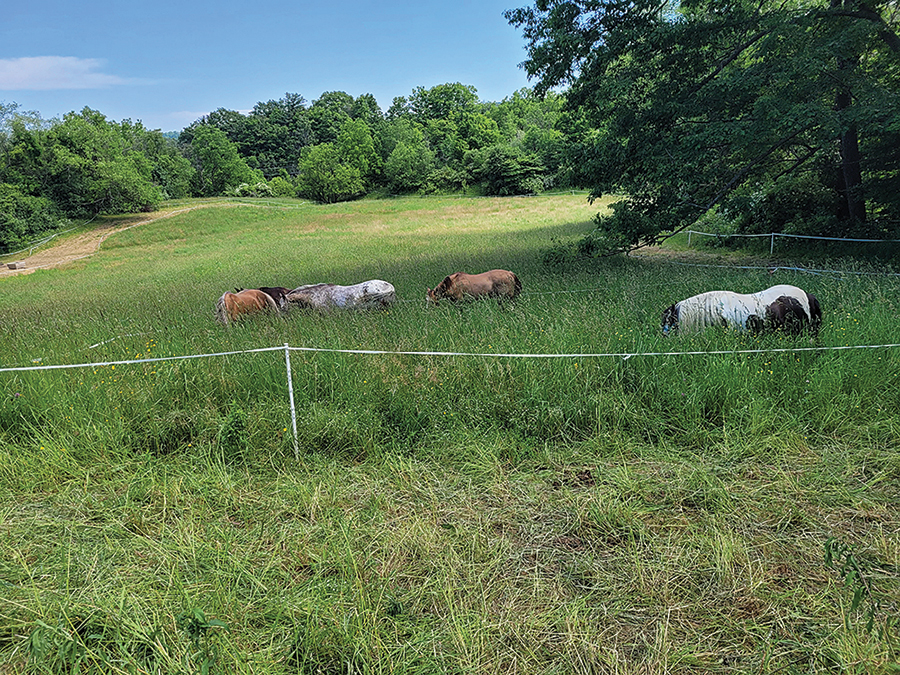
The managed grazing concept comes from the extensive work by Allan Savory https://savory.global/find-your-path/ . A fundamental aspect of this concept is to get the animals grazing only on fresh, varied and mature pasture. Our grazing spots are like opening a new buffet for the horses each day. It is fascinating to watch them graze. They eat what they like first (horses’ version of dessert) and then gradually consume most of the palatable forage (the healthy stuff!) throughout the spot. The forage does not get short, stressed and packed with sugar.
We sampled, classified and tested the pasture throughout the grazing season. The samples were taken to replicate what species and heights the horses were grazing and analyzed by SGS Labs in Guelph.
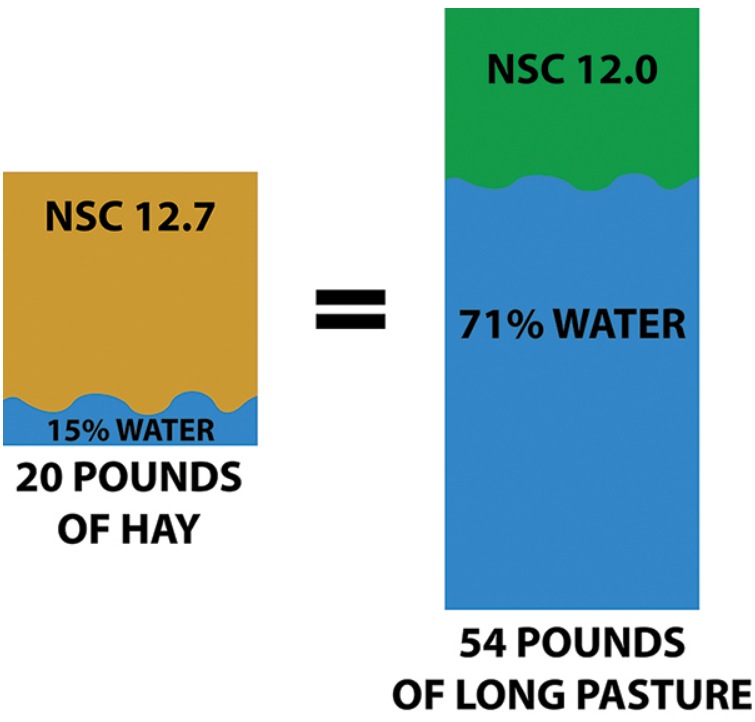
Since pasture is mostly water, a horse needs to eat lots of it to get their daily nutritional needs. The figure below compares what a typical 1000 pound horse would have to eat: 20 pounds of typical 2023 Ontario hay equated to 54 pounds of our long pasture in 2024! That keeps the horses busy grazing.
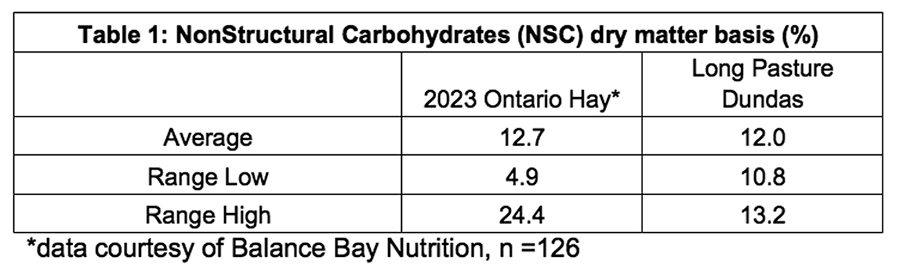
Given our laminitic episode, I worried about the sugar content of the managed pasture. Low sugar hay (less than 12% Nonstructural Carbohydrates) is recommended for susceptible horses. All the pasture samples were taken mid-day on sunny days, for consistent sugar measuring. I was surprised to learn that the NSC of the pasture our horses were consuming was lower than that of average hay in Ontario in 2023 (Table 1).
Table 1:
In 2024, we also changed how the horses foraged. We believed that our easy keepers still needed grazing muzzles. We had tried every commercial grazing muzzle over the years but had issues with reliability, tooth wear and discomfort. The horses hated them and would turn away when we put them on. This experience was in contrast to how content the horses seemed when eating hay through netting on their OptiMizers. So, we decided to make our own grazing muzzles with the netting from the OptiMizer. And a new product was born: NUZZLE, the gentle grazing muzzle. The Nuzzles worked really well. They significantly reduce consumption and the horses accept them willingly.
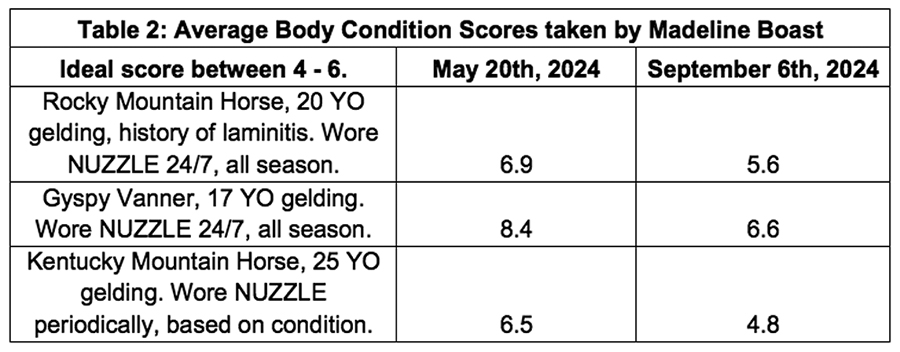
Madeline Boast used the Henneke body scoring system to assess the condition of the horses at the beginning and end of the season. We were delighted with their ideal results (Table 2). We attributed the improvements primarily to their nutrition and also due to increased walking around their track.
Table 2:
Our horses are now spending their 3rd season on their track with managed grazing in Dundas. The 2 easy keepers will likely wear their NUZZLES all season. This research has taught me not to fear the long, lush grass available to our horses. In fact, I was surprised to learn that our long, unstressed pasture is lower in sugar than typical hay available in Ontario. And it makes me really happy to see our horses healthy and contentedly grazing around their picturesque pasture.
Source: Wishing Well Services Ltd.
